Tell us about the job
Takes about a minute. No obligation.
A heat pump here runs heating duty through cold winters and switches over for summer cooling, which means the compressor and reversing valve cycle through more total load than they would on a single-mode system. Homes in Southeastern Connecticut Planning Region, CT run heat about eight months a year, from October through May. The cold end of that season is where the equipment works hardest, because a heat pump loses capacity as outdoor temperatures drop, and a system that was undersized or installed with insufficient back-up heat shows that strain in the compressor and refrigerant circuit first. When a contractor is diagnosing a repair, those are the components that come apart for inspection before anything else.
Ductwork and wiring aside, what a heat pump repair turns on is what the opened unit actually contains: corroded coil connections, refrigerant that does not match any current formulation, or a compressor whose replacement parts are no longer stocked by the original manufacturer. Half the homes in Southeastern Connecticut Planning Region, Connecticut were built in 1969 or earlier (2020-2024 ACS 5-year). A house that old was not built around a heat pump, so the system running in it was retrofitted into conditions it was not designed for, and the wear pattern inside reflects that. A contractor working through a repair here checks part availability before quoting the fix, because the sourcing problem can change what gets replaced and what gets recommended instead.
The Parts of a Heat Pump a Contractor Checks First
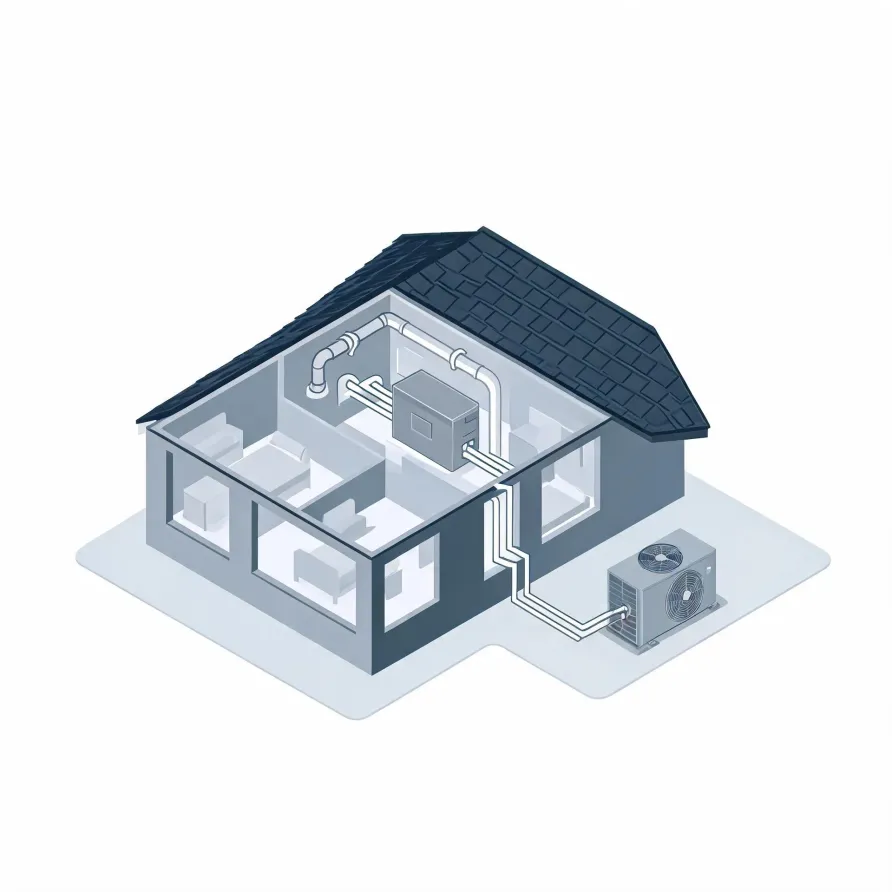
The outdoor unit is the piece most homeowners recognize: a metal cabinet that sits on a pad beside the house and holds the compressor and the outdoor coil. The compressor is the heart of the system, and when a heat pump stops moving heat in either direction, that is where a contractor looks first. The outdoor coil works alongside it, and a bent or blocked coil will show up as poor performance across the whole system.
Inside the house, the air handler contains the indoor coil and the blower that pushes conditioned air through the home. The expansion valve sits between the two coils and controls refrigerant flow; when it sticks or fails, the symptoms can look like a compressor problem, so a contractor works through both. The refrigerant lines running between the units and the reversing valve, which is what lets a heat pump both heat and cool, round out the pieces a repair call will cover.
The drawing shows a typical layout, and a licensed contractor determines which components and conditions apply to your specific home.
Find a contractor in Southeastern Connecticut Planning RegionSoutheastern Connecticut Planning Region by the Numbers
Half the homes in Southeastern Connecticut Planning Region, Connecticut were built in 1969 or earlier (2020-2024 ACS 5-year).
U.S. Census Bureau, 2020-2024 American Community Survey 5-Year EstimatesSoutheastern Connecticut Planning Region, Connecticut holds 126,425 housing units (2020-2024 ACS 5-year).
U.S. Census Bureau, 2020-2024 American Community Survey 5-Year EstimatesOwners occupy 65.1% of the occupied homes in Southeastern Connecticut Planning Region, Connecticut (2020-2024 ACS 5-year).
U.S. Census Bureau, 2020-2024 American Community Survey 5-Year EstimatesHeat Pump Repair Rules for Southeastern Connecticut Planning Region, Connecticut1 codes, standards & licensing rules
Licensing Rules for HVAC Repair in Southeastern Connecticut Planning Region, Connecticut
Connecticut requires a state licence to perform, or to advertise, heating, piping and cooling work: no person may practise an occupation this chapter covers without first obtaining one.