Tell us about the job
Takes about a minute. No obligation.
A heat pump repair in this area starts with the compressor and the reversing valve because those two parts bear the full weight of the heating load. Homes in Northeastern Connecticut Planning Region, CT run heat about eight months a year, from October through May. Across a run that long, the compressor cycles repeatedly against cold outdoor air, where the refrigerant pressure differential is at its worst and the motor works hardest. The reversing valve takes every switch between heating and cooling mode, and fatigue there shows up as incomplete switching or a stuck position. A contractor diagnosing a failed heat pump here checks those components before anything else, because the accumulated heating hours make them the likeliest place the fault lives.
Half the homes in Northeastern Connecticut Planning Region, Connecticut were built in 1973 or earlier (2020-2024 ACS 5-year). Ductwork laid out for a gas furnace or an old central air system was sized and routed for airflows that a heat pump does not replicate, and that mismatch shows up when a contractor opens the system and traces why a zone is running short. A refrigerant problem or a failed reversing valve is a bounded repair. Ductwork that was never meant for this kind of equipment is a different scope, and a contractor working on a heat pump in this region measures and pressurizes before pricing anything.
The Parts of a Heat Pump a Contractor Checks First
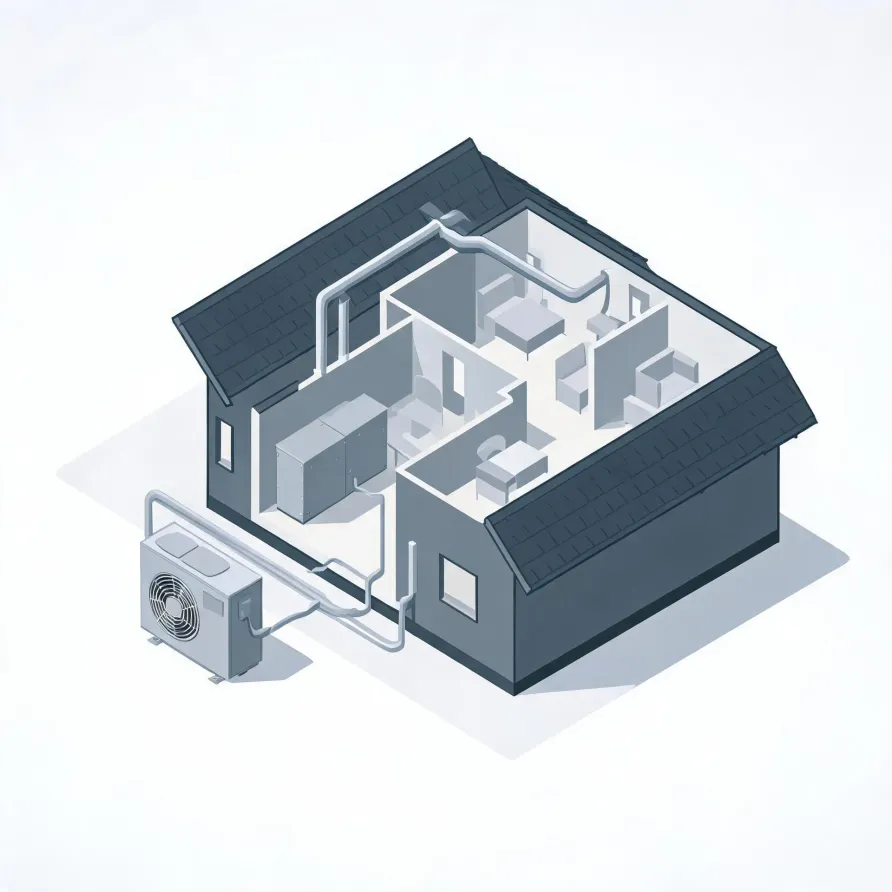
The outdoor unit is the piece most homeowners recognize, a cabinet that sits on a pad beside the house and holds the compressor and the outdoor coil. The compressor is where most repair calls begin. When it fails, the system runs but moves no heat. The outdoor coil sits around it, and a bent or dirty coil can produce the same symptom.
Inside the house, the air handler holds the indoor coil and the blower that pushes conditioned air through the home. The reversing valve lives inside the refrigerant circuit and is what allows the system to heat in winter and cool in summer. A contractor also checks the expansion valve, the refrigerant lines that connect both units, and the controls and sensors that tell the system when and how to run.
The drawing shows a typical layout, and a licensed contractor determines which components apply to your specific system and what work each one needs.
Find a contractor in Northeastern Connecticut Planning RegionNortheastern Connecticut Planning Region, by the numbers
Half the homes in Northeastern Connecticut Planning Region, Connecticut were built in 1973 or earlier (2020-2024 ACS 5-year).
U.S. Census Bureau, 2020-2024 American Community Survey 5-Year EstimatesNortheastern Connecticut Planning Region, Connecticut holds 41,736 housing units (2020-2024 ACS 5-year).
U.S. Census Bureau, 2020-2024 American Community Survey 5-Year EstimatesOwners occupy 77.3% of the occupied homes in Northeastern Connecticut Planning Region, Connecticut (2020-2024 ACS 5-year).
U.S. Census Bureau, 2020-2024 American Community Survey 5-Year EstimatesHeat Pump Repair Rules for Northeastern Connecticut Planning Region, Connecticut1 sourced standards and codes
Licensing and Legal Requirements in Northeastern Connecticut Planning Region, Connecticut
Connecticut requires a state licence to perform, or to advertise, heating, piping and cooling work: no person may practise an occupation this chapter covers without first obtaining one.