Tell us about the job
Takes about a minute. No obligation.
A contractor quoting a heat pump repair here starts with the refrigerant circuit and the reversing valve before looking at anything else. Homes in South Central Connecticut Planning Region, CT run heat about eight months a year, from October through May. Across a heating season that long, the reversing valve cycles between heating and defrost mode repeatedly, and the refrigerant circuit runs under sustained low-temperature demand that accelerates wear on seals and coils. A unit that was undersized at installation shows compressor strain sooner here, because it never gets the idle time that would otherwise mask a marginal charge or a developing leak.
Ductwork and wiring routed for one generation of equipment and then handed off to another tend to accumulate the evidence of every change in between. Half the homes in South Central Connecticut Planning Region, Connecticut were built in 1964 or earlier (2020-2024 ACS 5-year). A heat pump installed into stock this old may be sitting on electrical service that has been extended more than once, with line sets and connections that reflect the system before the current one. When a contractor opens the unit for a repair, what they find inside tells them whether the compressor, reversing valve, or capacitor they are pricing is the straightforward version of that job or whether the surrounding infrastructure is adding scope. Parts availability for equipment running in houses this age varies, and a contractor who has worked this area knows to check that before a quote is final.
The Parts of a Heat Pump a Contractor Checks First
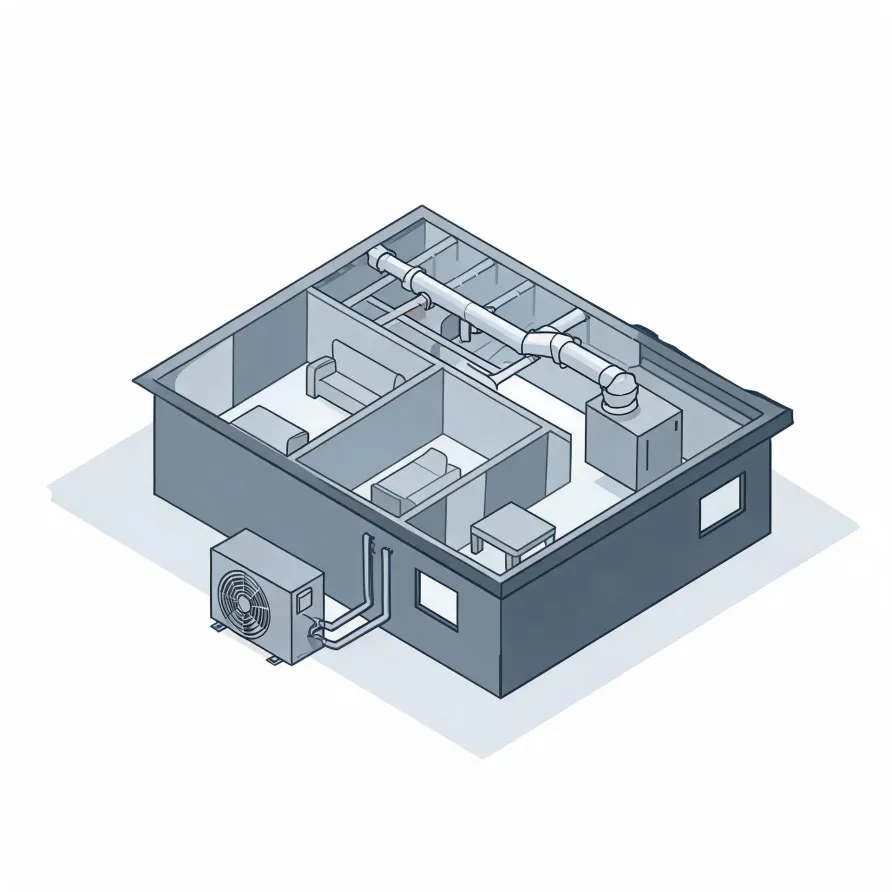
The outdoor unit sits on a pad beside the house and holds the compressor and condenser coil. These are the pieces a contractor goes to early, because the compressor moves the refrigerant that carries heat and the coil is where that heat transfers. When either one is the problem, you tend to feel it fast: the system runs but the house stays wrong.
Inside, the air handler or indoor coil sits in a utility space, attic, or closet and handles the other half of that exchange. The refrigerant lines connect the two units, and the reversing valve inside the outdoor cabinet is what lets the system switch between heating and cooling. A fault in the valve, a leak in the lines, or a failed capacitor near the compressor are among the places a contractor looks when the system is not behaving.
The drawing shows a typical layout, and a licensed contractor determines which parts apply to your specific house and setup.
Find a contractor in South Central Connecticut Planning RegionSouth Central Connecticut Planning Region, by the numbers
Half the homes in South Central Connecticut Planning Region, Connecticut were built in 1964 or earlier (2020-2024 ACS 5-year).
U.S. Census Bureau, 2020-2024 American Community Survey 5-Year EstimatesSouth Central Connecticut Planning Region, Connecticut holds 248,267 housing units (2020-2024 ACS 5-year).
U.S. Census Bureau, 2020-2024 American Community Survey 5-Year EstimatesOwners occupy 60.5% of the occupied homes in South Central Connecticut Planning Region, Connecticut (2020-2024 ACS 5-year).
U.S. Census Bureau, 2020-2024 American Community Survey 5-Year EstimatesCodes & Standards Governing Heat Pump Repair in South Central Connecticut Planning Region, Connecticut1 sourced rules & standards
Contractor Rules in South Central Connecticut Planning Region, Connecticut
Connecticut requires a state licence to perform, or to advertise, heating, piping and cooling work: no person may practise an occupation this chapter covers without first obtaining one.